How this service works
This service enables systems to request and exchange information across organisational boundaries.
Overview
This service enables systems to request and exchange information across organisational boundaries. Rather than storing data centrally, it connects systems so that information can be requested from the system that holds it at the point it is needed, and returned in a consistent format.
This approach ensures that systems are working with up-to-date information from the original source. It reduces duplication and helps organisations maintain control of their own data while making it available to others when needed.
You can also explore when to use this service to understand how it applies in practice.
Core structure of the service
System architecture and key components
At a high level, the service consists of:
- consumer systems that request and use data
- producer systems that provide data
- shared services that support routing, lookup or messaging
- standard interfaces (APIs) that define how systems connect and communicate
These components work together to allow information to be accessed consistently across organisations and care settings, without requiring direct connections between every system.
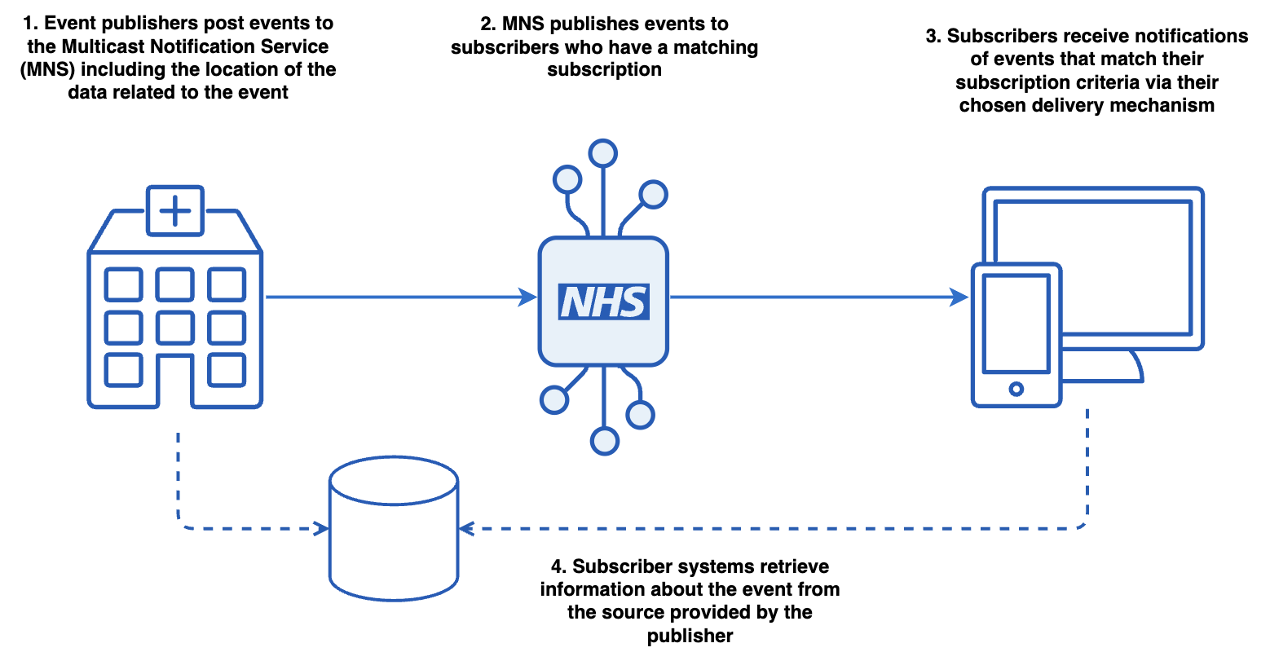
This diagram shows how systems connect and how requests are routed and responses returned.
How data flows through the service
The service supports a request-and-response model for accessing information between systems.
This would typically follow this pattern:
- A consumer system requests information about a patient or event.
- The service uses supporting services to identify the correct source system.
- The request is routed to the relevant producer system.
- The producer system returns the requested data.
- The response is returned to the consumer system in a consistent format.
This allows systems to access information directly from the source system at the point of need, rather than relying on locally stored copies.
Depending on the use case, this process may include additional steps such as validating the request, handling different types of data, or interacting with more than one source system.
How systems interact
Systems interact with the service through standard interfaces (such as APIs), which define how requests and responses are structured and exchanged.
This allows:
- consistent communication between different systems
- secure exchange of information between organisations
- independent systems to work together without tightly coupling to each other
Typical interaction patterns include:
- requesting information from another system at the point of need
- sending updates or notifications between systems
- exchanging structured messages as part of a workflow across organisations
These interaction patterns support services that operate across organisational boundaries rather than within a single system.
Example interaction
For example, a system used by a clinical team may need to access patient information held in another organisation’s system.
In this case the:
- consuming system sends a request through the service
- service identifies which system holds the required information
- data is retrieved from that system
- response is returned and used as part of the clinical workflow
This allows teams to access relevant information from other organisations without needing direct point-to-point integrations between systems.
How this service works with other services
To deliver a complete solution, most use cases require integration with other NHS services and APIs. These services typically work together to support different parts of the process, such as identifying patients, locating systems, and exchanging information.
The examples below show common dependencies, how they are used, and where you may need to combine or choose between them depending on your use case. You can explore how these services work together in practice in the implementation and integration guidance.
| Service | Relationship |
|---|---|
| Personal Demographics Service (PDS) | PDS holds the registered GP for all patients, as an ODS code. For some products, the consumer system must retrieve the registered GP from PDS. |
| Spine Directory Service (SDS) | SDS holds details of GP system 'endpoints'. For some products, the consumer system must retrieve the GP system endpoint for the registered GP's IT system. |
| National Care Records Service (NCRS) | NCRS is developing integration with this service. |
| Message Exchange for Social Care and Health (MESH) | For some products, the consuming system must send messages to the GP system via MESH. |
You may also want to consider other services that perform similar functions to this, depending on your use case.
Last edited: 23 June 2026 12:48 pm