New care models case study
Find out more about new care models, including what they are, how to use the new functionality and a PCN and XML case study.
1 July 2022 changes to naming of CCGs and STP
This page was created before the 1 July 2022. Any reference to Clinical Commissioning Group (CCG) should now be the new Sub ICB Location. Any reference to STP should now be (integrated care board (ICB).
The Organisation Data Service (ODS) have published information over the last three years about some major changes being made to Organisation Reference Data (ORD).
The changes are:
- a new code structure (ANANA) for new organisation identifiers allocated by ODS from 1 April 2020 onwards - codes issued prior to this date will not be converted
- a new data model in an XML release format for ORD data, which is currently being dual run alongside our legacy CSV files - these legacy files will be withdrawn by November 2021
These changes are being made to address a range of known issues and to ensure ORD can continue to meet user needs.
More information can be found in our ORD Changes Information Portal and in the Information Standards Notice DCB 0090.
What this means
NHS organisations and their suppliers need to ensure processes and systems are ready to use the new codes as early as possible. Usage will depend on local business operation needs.
From April 2020 all new ODS codes in scope for these changes will be published in the new format. This will result in a mixed economy of codes within organisation reference data – for example, an NHS Trust code and its site codes issued before April 2020 will be in the old format; any site codes issued after the change will be issued in the new ANANA format. Systems must be able to accommodate this mixed economy.
Using the new functionality
Much of the new granular data (in particular the relationships) are only available in XML or the API feed. For example, where a new site has been allocated an ANANA code, systems must consume and interpret meta data in the XML to identify the parent organisation and/or to understand the organisation type/role of that site.
Although the .csv files will continue to be produced until April 2021, their usefulness is already degrading. All new functionality introduced since the XML went live in 2017 has not been added to .csv – amongst this functionality is:
- Organisation Role meta data (such as the ‘type’ of an organisation)
- Named Relationships (giving context to each relationship, such as ‘Is Commissioned By’)
- operational dates (additional open/close dates for organisations and start/end dates for relationships that indicate status in Spine)
Introduction of new care models
During the last 12 months, many new complex care models have been introduced into the health and social care landscape. First among these are Sustainability and Transformation Partnerships (STPs).
STPs represent a step-change in the way health and social care organisations interact with one another in that they form large membership groupings. Whereas an NHS Trust, for example, could only be linked to a single NHS England Local Office at any given time – and this would only change as a result of reconfiguration at NHS England level – individual Trusts are seen to contribute to multiple STPs. This means the relationships represented in ODS data must move away from a relatively simple, straightforward hierarchy to something more like a spider web of multiple relationships.
This is a substantially more complex situation to the model within organisation reference data – a complexity that is increased by the fact that these relationships are likely to be fluid and change over time. The picture is set to become even more layered and nuanced with additional care models being introduced, including Integrated Care Systems and Primary Care Networks.
Multiple relationships are impossible to convey through the existing .csv products, whereas these complex organisational structures are easily modelled in XML. However, this approach does mean that some programmes, teams and suppliers may need to convert to consumption of XML earlier than they originally thought.
Case study – PCN and XML
The long-term plan is introducing large scale and radical changes to the structure of the organisations in the NHS, at considerable pace.
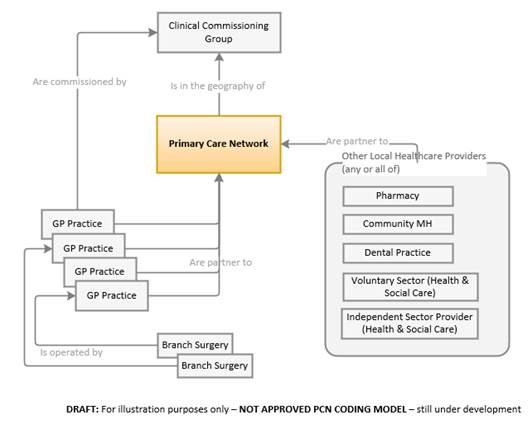
NHS England are introducing a new care model called Primary Care Network (PCN). This is a grouping of GP practices working together with community, mental health, social care, pharmacy, hospital and voluntary services to deliver care at neighbourhood level.
This introduces a new entity to the NHS hierarchy alongside a practice and establishes a new relationship in addition to that with the CCG.
See a draft relationship model:
It's anticipated that systems will need to:
- store and publish data at PCN level
- view PCN relationships to GP Practices, branch surgeries and other local healthcare providers
- identify PCNs as an entity to facilitate particular data flows or processes
It's unclear when PCNs will start this activity. Trailblazer sites may wish to go live soon. In order to make use of the allocated PCN codes, systems would have to make changes to:
- load XML data
- load new additional data and functionality delivered by XML, such as multiple relationships and new organisation types/roles (simply migrating the existing feed to XML will not be sufficient)
Last edited: 19 August 2019 9:27 am