Data Access Request Service (DARS)
NHS England’s Data Access Request Service (DARS) is a gateway to accessing NHS health and social care data.
NHS England’s Data Access Request Service (DARS) is used to request access to NHS health and social care data for purposes beyond direct patient care. DARS ensures that legal, ethical and security requirements are met, and the privacy of the people whose data we hold is safeguarded.
We have provided an overview of the DARS service including how to request access to data through DARS and information to support your request, including guidance, agreements, charging and timelines:
About this service
DARS enables the health and social care system to make best use of its data to improve health care outcomes, including research powered by data, planning and commissioning of services, policy development, and improving the quality and efficiency of healthcare delivery.
Learn more about the role NHS England plays in health data and how we use data.
The Data Uses Register provides information about organisations who have used DARS and the reason for their access.
Learn how we work with different stakeholder groups to help us shape and improve DARS.
Data available through DARS
ICB’s and commissioners should visit Data Services for Commissioners (DSfC) to understand more about data available for access.
Information about data available through DARS, including data sets, metadata, and services to access the data available for each data set is below.
You may be able to use data which is already published to meet your needs which means you do not need to make a request through DARS. More information can be found on our statistical publications, open data and data products page.
Access this service
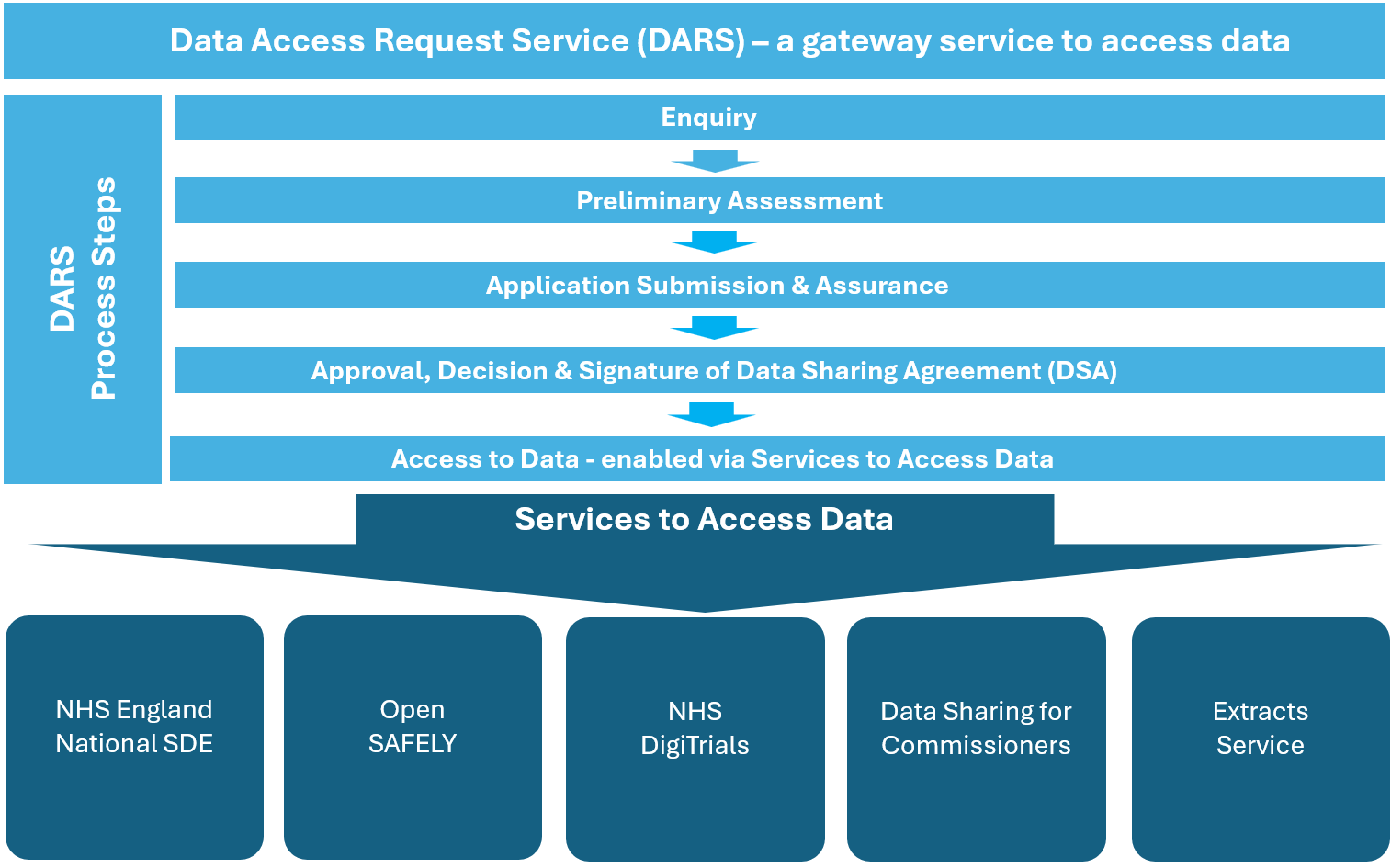
DARS provides a gateway for customers to access data through a range of services. The steps in the DARS process ensure that customers are matched to the service to access data which best meets their requirements.
To gain access to data organisations must make a successful application through the DARS process. The steps within the DARS process ensure that data access which is approved meets legal, ethical and security requirements.
Timelines
The timeline for a DARS request is based on a number of factors specific to the application. Within 1 to 2 weeks of submitting your enquiry the DARS team will contact you to work through your request and carry out the preliminary assessment.
The preliminary assessment enables the DARS team to take into account the specifics of your request to provide you with an indication of how long it will take for you to be able to gain approval to access data.
After your Data Sharing Agreement is approved, the time taken to access data will depend on a number of factors and the service used to access data. There are also dependencies around the level of demand which the DARS team are servicing.
DARS charges
The DARS team works with customers during the preliminary assessment to estimate the charges to meet their needs. This ensures that all key components that influence charges are understood at an early stage and that you are matched to the best service to meet your needs.
As charges cover the cost of processing and delivering the service, components considered include the type of application, the volume of data requested, including any data linkage, the frequency of data required, and the service used to access data. Final charges to access data are agreed during the application process.
Learn more about current charges for DARS, OpenSAFELY, and extracts.
Data sharing contracts and agreements
The DARS process ensures that relevant contracts and agreements are in place for data access. This includes an organisational level agreement, known as a Data Sharing Framework Contract (DSFC), and for each request to access data a Data Sharing Agreement (DSA). For some services to access data, a service agreement will be required to cover the terms of access to that service.
Information for customers with a DSFC and DSA
Data access that has been approved is summarised in a document known as a Data Sharing Agreement (DSA). A DSA is specific to each request for data, and must be signed by both the applicant organisation and NHS England before the approved data can be accessed. To gain a DSA, the organisation must have a DSFC in place with NHS England.
Those with a DSA are encouraged to familiarise themselves with important information on being a DSA holder, and on their DSFC with NHS England. This ranges from information on what happens once a DSA is signed and approved data access can begin, how information is published on your DSA, and how to make a change to your DSA. It also includes information on audits and reviews which may be undertaken for the DSA and DSFC, and what you need to know when a DSA or DSFC is due to expire.
Contact details
For enquiries, contact DARS. Enquiries are signposted to the relevant subject matter experts who will manage the response.
If you have a request going through the DARS process or an enquiry relating to an existing Data Sharing Agreement, include your NIC reference number to help us signpost it to the relevant expert.
Last edited: 28 August 2026 12:54 pm