Based on their joint presentation at Digital Health Rewired in spring 2026.

Helping the NHS respond to rising pressure
Everyone recognises that the NHS is under significant pressure. 40% of people who go to their GP or to A&E could be effectively served elsewhere. Patients are struggling to navigate the NHS, often presenting at higher acuity care settings, compounding the challenges of demand and delays.
Whilst progress is being made to improve referral to treatment times, currently only 65% of people start treatment within 18 weeks. With preventable illness accounting for 40% of the NHS budget, it is also clear the time has come to take a more proactive approach to helping people stay well.
The NHS App, and digital services more broadly, can play a vital role in relieving the pressure the NHS, and the people it serves, are under. The NHS App is focusing on 3 priority areas:
Streamlining access to unplanned care
For people: we’re using AI-assisted triage technologies (which will include clinical review) to provide faster access to the right service first time, including providing an appointment if needed.
For the NHS: helping to safely divert and reduce avoidable demand, and increase efficiency.
Making planned care more efficient
For people: one place to manage all appointments, referrals and interactions - putting patients in control.
For the NHS: increase capacity by reducing missed appointments, reducing referral-to-treatment times and waiting lists. Some provider trusts with all NHS App features enabled have seen a 25% lower missed appointment (DNA) rate. Plus saving money on printed letters, postage and SMS messaging.
Reducing future demand
For people: enabling people to control their own health through easier access to services, better understanding health risks and increasing access to prevention, early intervention and early diagnosis.
For the NHS: improving public health, reducing future demand and spend on preventable conditions through screening, vaccination and other preventative health services.
Bringing this to life
An early-stage, illustrative prototype shows what this could look like in the NHS App.
Alex isn't a real person, but a persona created to help our team design how the app can best support him. Alex is 39, stopped smoking 6 months ago, and was recently diagnosed with type 2 diabetes. He's had a persistent cough for 4 weeks and feels it’s getting worse.
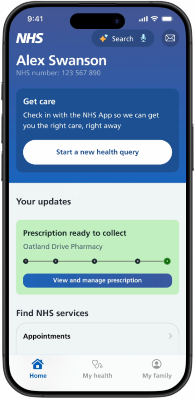
Instead of calling his local GP practice, Alex opens the NHS App, which is personalised and already knows his essential facts. It asks him some questions and refers him for diagnostic tests, prompting him to book an appointment - straight away in the app.
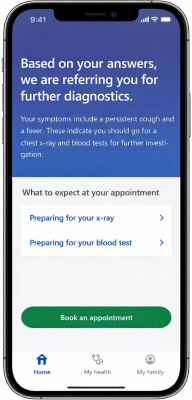
All of this takes just a few minutes. No 8am rush to call the surgery, no appointments, no forms to fill in.
The app is a central source of all the information Alex needs. It shows him all his appointments and referrals. It helps him monitor his symptoms and automatically shares the appropriate data with his hospital and GP.
Crucially, the app can offer additional personalised help proactively. It invites him to complete an NHS Health Check online, and to sign up for local COPD (chronic obstructive pulmonary disease) classes.
The NHS App vision – a lifelong companion
As this vision becomes reality, the NHS App will become a true companion. It's not a doctor or nurse, it's not there to treat symptoms. But it knows about you and it knows about services the NHS can offer. It’s all about context and connections. The app helps to spot gaps in healthcare, and plug them with appropriate next steps, supporting people to take the next best action for them.
3 in 4 people in England have the app and 27% of the population are using it every month.
The app is already delivering proven benefits for patients and the system, and we know people are using it more frequently as we add more valuable functionality and services.
The moment is now
Just like other aspects of daily life, from shopping and banking to information and entertainment, millions of people now take a digital first approach to engaging with healthcare, using the app as their front door to the NHS.
Continuing to evolve the app to make it truly personalised will help us create an NHS that meets people where they are – at home and on demand. And it will support healthcare staff with tried, tested and constantly improving digital services built for the NHS, by the NHS.
Ensuring no-one is left behind
Of course, the NHS App is just one part of a much bigger picture. It complements non-digital services, which remain essential for people without access to, or confidence in, digital tools.
Inclusion is built in from the start. We work with community, charity and industry partners, using inclusive design and testing with diverse and seldom heard groups to ensure the app works for everyone. And through our libraries partnership, people can get in-person help to set up and use the NHS App in trusted local spaces.
Supporting the NHS together
We know digital alone will not solve the pressures our NHS is under. We need to work together with the system to unlock the full power of the NHS App.
If you work in the NHS system and you'd like to contribute, here are some ways you can get involved:
- Work with us to create an adoption plan for your area (think about staff and patients).
- Use our dashboard to measure progress and target usage (look on the NHS Futures website and search for NHS App).
- Keep an eye on the public roadmaps for the NHS App and for Digital Prevention Services.
- Take up improved NHS England support offers for training, and joint planning.
- If you don’t already have one, appoint an app ambassador to champion the NHS App.
- Plan ahead for full app integration by 2027.
Get in touch
Contact us at [email protected]



Authors


Latest blogs


Last edited: 13 May 2026 4:37 pm