NHS England Terminology Server environments
An overview of the Terminology Server environments and how FHIR terminology resources move through them before publication.
The NHS England Terminology Server has four environments for developing, testing and publishing FHIR terminology resources (code systems, value sets and concept maps).
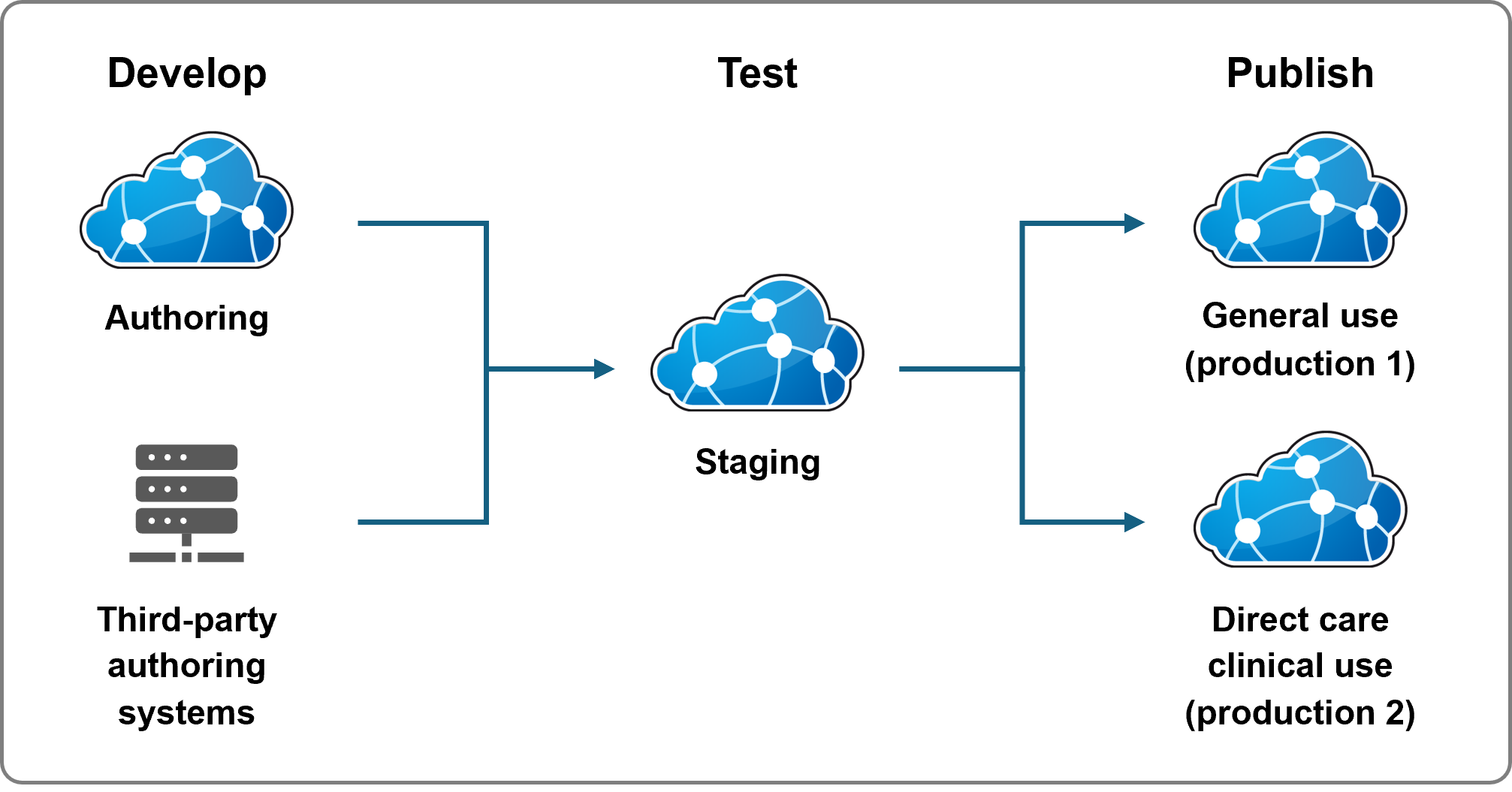
The environments are:
- Authoring
For developing FHIR terminology resources. - Staging
For testing FHIR terminology resources. - General use (production 1)
For publishing FHIR terminology resources to be read by any user or system. - Direct care clinical use (production 2)
For publishing FHIR terminology resources to be read by live clinical systems that support direct care.
There is also a syndication server for retrieving available releases for use in local terminology servers or similar systems and for receiving notifications of new resources.
Each environment and the syndication server can be seen as an endpoint (the URL that people and systems use to connect to read or author FHIR terminology resources). By changing the endpoint you're changing the environment you're connecting to.
To access these, see How to access.
Staging environment
Staging is similar to a traditional test environment.
When a FHIR terminology resource is created, either in authoring or externally, it can be loaded into staging so it can be assured in a production-like environment.
Staging allows owners to review the resource and assess its impact on related resources.
Once the owner is satisfied with the resource in staging, it can be promoted to the general use (production 1) and direct care clinical use (production 2) environments.
General use (production 1) and direct care clinical use (production 2) environments
There are two production environments:
- General use (production 1)
- Direct care clinical use (production 2)
Both environments contain the same FHIR terminology resources but are designed for different purposes.
General use (production 1) environment
This is a high-performance, general-use environment for analytical and back-end functions. It can also be used for system development and resource-intensive activities, such as data migration.
Direct care clinical use (production 2) environment
This is also a high-performance environment, reserved for live systems that support direct care (see what we define as direct care). This helps maintain the capacity and performance needed for direct care services.
Last edited: 16 October 2026 2:08 pm