National Imaging Registry (NIR)
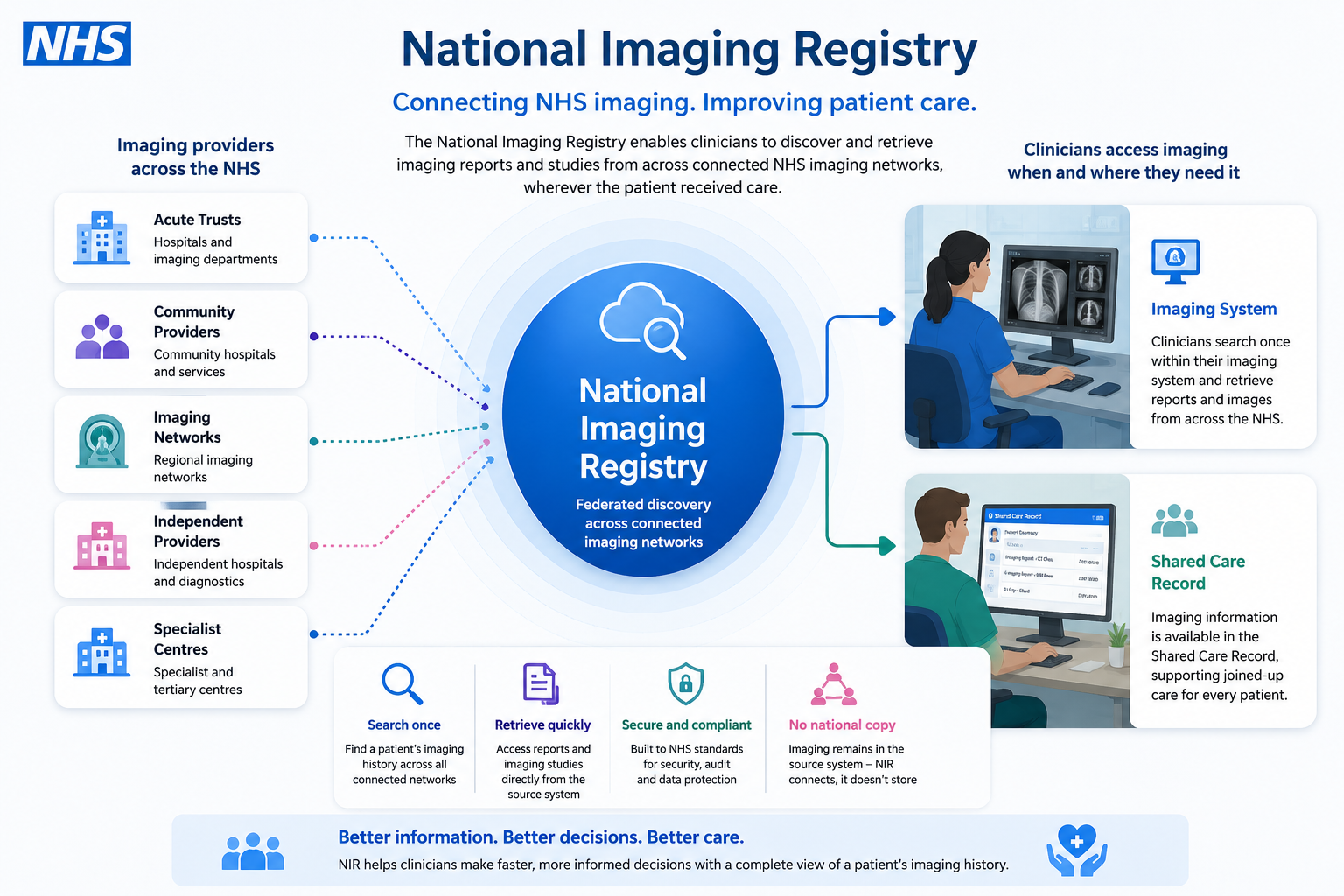
The National Imaging Registry (NIR) lets clinicians securely access a patient’s imaging history and reports from other organisations in England, supporting safe, real‑time image sharing so imaging follows the patient across care settings.
About this service
The National Imaging Registry (NIR) is a strategic digital service developed as part of NHS England’s Diagnostics Digital Capability (DDC) Programme. It provides a standards-based national infrastructure that enables interoperable access to diagnostic imaging and reports across NHS and approved independent sector organisations.
NIR enables and supports healthcare providers and clinical systems in accessing prior imaging, supporting safer clinical decision-making, reducing unnecessary repeat scans, and improving coordination of care across pathways and organisations.
NIR Project Background has more information about the history of NIR as a project.
Who this service is for
You can use this service if you are part of:
- clinical organisations, networks and trusts (NHS and private providers)
- clinical teams and radiologists
- cancer multidisciplinary teams (MDTs) and cross-site specialties
- clinical and imaging system suppliers
Benefits
- reduced duplication of imaging, improving patient safety and clinical productivity
- improved equity of access to diagnostic imaging across England
- easier access to prior imaging for MDTs and cross-site working
- reduced reliance on image transfer portals and associated licensing costs
- environmental benefits through reduced data transfer and re-imaging
- reduced health inequalities, consistent access to imaging regardless of geography
- improved clinician wellbeing, less time spent chasing images, more time with patients
- better system efficiency, fewer repeats, lower costs, faster throughput
- improved data quality, leveraging standardised metadata
- enhanced safety, reduced risk of misdiagnosis due to missing priors
Examples of use
Clinicians and healthcare teams use the NIR to find and view diagnostic images and reports quickly from other NHS sites and approved independent providers.
NIR helps ensure that imaging follows the patient; improving safety, reducing delays, and cutting down on unnecessary repeat scans.
| Use case | Desired clinical outcome | Desired patient outcome |
|
A stroke specialist can instantly view CT images taken at a local hospital before a patient transfer. |
Imaging from referring hospitals is immediately available at the point of care, enabling faster, better‑informed clinical decisions and reducing delays in time‑critical stroke pathways. |
Patients and families feel reassured that clinicians have the most up‑to‑date scans on arrival, supporting faster, more confident treatment decisions and improving outcomes in time‑critical stroke pathways. |
|
Cancer multidisciplinary team (MDT) members can review MRI and PET scans from several hospitals in one session. |
MDTs can reliably access prior imaging across sites, ensuring decisions are never delayed by missing scans and reducing the need for repeat imaging. |
Patients experience faster cancer care with fewer delays, reduced radiation exposure, and less travel burden thanks to fewer duplicate scans and timely MDT decision‑making. |
|
Radiologists can compare current studies with previous ones from another trust for better reporting. |
Radiologists have full access to a patient’s imaging history, supporting more accurate reporting, streamlined workflows, and eliminating delays caused by waiting for external prior studies (especially in emergency settings). |
Patients gain greater trust in their diagnosis and treatment because decisions are based on their complete imaging history. More accurate reporting also reduces unnecessary follow‑up scans. |
|
Independent providers carrying out NHS-funded work can securely share results back with referring NHS teams. |
Secure, timely sharing of imaging and reports between independent providers and NHS teams reduces clinical delays, prevents duplicate testing, and strengthens continuity of care across organisational boundaries. |
Patients receive quicker diagnoses, fewer repeat appointments, and a smoother care journey as results flow promptly and securely back to their NHS team, regardless of provider location. |
|
A private healthcare provider transfers a patient to a public sector specialist team. |
Both public and private clinicians can access complete imaging and reports, reducing administrative burden, avoiding unnecessary repeat scans or MDT referrals, and accelerating clinical decision‑making during transfers. |
Patients receive consistent, efficient care across public and private providers, avoiding unnecessary repeat scans and benefiting from faster, better‑informed clinical decisions during transfers. |
NIR connects existing hospital systems, so there’s no new platform or user interface to learn; just faster, safer access to the images and reports clinicians need.
Care providers who are not sure if NIR can help them are encouraged to discuss their initial concerns with the NIR Clinical Lead, Dr Joe Barnett. Email: [email protected]. Dr Joe Barnett can help you with understanding if NIR is the right clinical product for your clinical use case.
How to access this service
National usage policy
The NIR is the national NHS service for sharing diagnostic images and reports safely between hospitals, imaging networks and approved independent providers.
Use of the NIR is recommended for all organisations that carry out NHS-funded imaging. It helps make sure that scans and reports follow the patient wherever they go, reducing duplication, speeding up diagnosis and improving safety.
During the national rollout, joining NIR will become available for all public and private healthcare organisations making use of imaging services across England.
Roadmap
Find out what we're working on now and what we plan to do in the future.
Status, service level and current usage
The NIR is currently moving towards a private beta go live phase, supporting live image and report sharing across NHS Imaging Networks and approved independent providers. A full national rollout is planned for 2026 to 2027.
This service is a bronze service, this means it's available 24 hours a day, 365 days a year and supported from 8am to 6pm, Monday to Friday excluding bank holidays. Availability and performance are monitored by NHS England to ensure reliability during core working hours. After private beta initial phases are completed, the NIR will move towards a gold standard service, which means 24 hours a day 365 days a year support.
Private beta usage
- live image sharing across 3 imaging networks
- thousands of diagnostic studies will be discovered or retrieved during the beta phase
- additional networks are preparing to join the next onboarding wave, including independent sector providers
- used by radiologists, reporting radiographers, and clinicians for direct patient care in live clinical workflows, using real data
Contact us
| Enquiry | Contact |
|---|---|
| Live service incident |
National Service Desk Email: [email protected] Report via our customer portal Telephone: 0300 303 5035 |
| General enquires |
NIR Product Team Email: [email protected] |
| Clinical enquires |
Dr Joseph Barnett - NIR Clinical Lead |
| Strategic direction and escalations |
Shan Rahulan Email: [email protected] |
Further information
Use this API to access patient imaging records across NHS and private healthcare networks. The National Imaging Registry (NIR) API allows authorised systems to view a patient’s imaging history, including examinations, diagnostic reports, and imaging studies.
As part of onboarding, you'll need to update your organisation’s privacy notice to explain how patient information is used and shared through NIR to support direct care, aligned to the NIR Privacy Notice.
Governance for the National Imaging Registry is in place to make sure the service is safe, secure, lawful and clinically appropriate to use.
This page provides the official register of software suppliers and end user organisations that have integrated with the National Imaging Registry (NIR) API.
We encourage suppliers and organisations onboarding to NIR to join the NHSE developer community to share questions and answers about NIR.
Last edited: 2 October 2026 8:32 am