Clinical Data Gateway
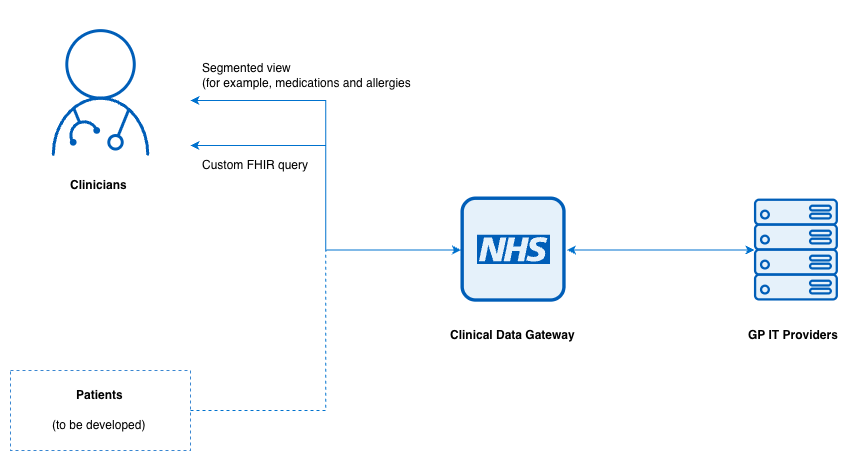
The Clinical Data Gateway makes structured GP record data available to appropriate clinicians and patients when and where they need it.
About Clinical Data Gateway
The Clinical Data Gateway (CDG) enables access to the GP record in a structured data format for the purpose of direct care.
The data retrieved using CDG is defined using the FHIR STU3 standard. It is based on GP Connect Access Record: Structured.
The Clinical Data Gateway aims to speed up integration by providing access to GP record data through a single RESTful API which finds and filters data from a patient’s registered GP practice. We plan to offer ways to retrieve predefined segments of the GP record through this API to suit specific use cases, for example Medications and Allergies data.
The API handles much of the routing and lookup complexity currently associated with accessing GP records.
Who it's for
Users of this service fall into the categories of:
- Clinicians: viewing a patient’s record to support clinical decision making and provide joined up care
- Patients: viewing their own patient record using the NHS App (to be developed)
The service enables real-time GP record data to be easily integrated directly into healthcare services, without the need for clinicians to use multiple services.
As part on onboarding, we’ll discuss your use case, which will define your level of access to GP record data.
For patients, it will help ensure that all patients see a consistent view of their GP record data, regardless of what IT system their GP surgery uses.
The Structured GP Record
This API represents the GP Record using the GP Connect data model.
You can currently retrieve data from GP practice records for the following areas: medications, allergies, immunisations, investigations, uncategorised data (other clinically coded items that are present in the record).
Data is also available for the following clinical areas, subject to the First of Type process. This is because it has not yet had an active consumer in a care setting: consultations, problems, outbound referrals, diary entries.
When to use Clinical Data Gateway
As part of the onboarding process, we will examine your use case and help ensure you’re accessing the right level of patient data. We support use cases for direct care. Examples of this might include:
- prescribing and dispensing
- supporting clinical triage
- providing a patient’s longer term clinical history
Care settings
Examples of how these use cases might work in practice include:
- pharmacies who need access to Medications data to support prescribing as part of the Pharmacy First service
- secondary Care institutions who need access to Medications data to perform Medications reconciliation on a patient’s admission to hospital
How to access this service
Authentication
This API is hosted on NHS England’s API Management Platform. To access this API, you will need to have implemented CIS2 authentication for your users. This ensures that access to GP Record data is adequately protected with strong authentication at a minimum of AAL2.
Technical integration
You may also need to onboard to the Patient Demographics Service (PDS) to be able to use this API. This is to perform an initial patient trace and obtain their NHS Number. If you can obtain the patient’s NHS number through another route, you will not need to integrate directly with PDS.
Clinical safety
As part of your onboarding, we will assess your integration to ensure that it is clinically safe. You must provide evidence demonstrating compliance with required standards.
This includes clinical risk management documentation (for example, DCB0129 / DCB0160 where applicable), Hazard log and mitigation evidence and Information governance confirmation.
Initial testing and expressions of interest
We are actively looking for consuming system suppliers to test our integration processes as part of a controlled beta/First of Type. This will allow us to collect feedback on the overall process, such as:
- our documentation
- our automated test suites and test packs
- our assurance process and how we support consumers
- how the service should evolve before wider rollout
If you’d like to express your interest, email: [email protected].
As part of this, tell us:
- your organisation name
- your product or system name
- your use case
- whether you currently use GP Connect
- what sections of the GP record you are hoping to access and why
- your willingness to support initial user testing and provide feedback throughout the onboarding process
We are particularly interested in suppliers with a clear direct-care use case and the ability to work closely with us during testing.
Roadmap
We will be building further functionality into this product over time. Whilst we cannot promise timelines, we expect to build the following items in the near future.
Curated views
Our intention is to develop endpoints that replicate commonly requested, clinically proven, groups of GP record data. This aims to reduce assurance burden and speed up onboarding.
Patient Facing Services
Our intention is for this API to also offer a Patient Facing Services endpoint for use in the NHS App. This allows patients to view their GP Health Record within the NHS App using a consistent data model.
Last edited: 11 May 2026 11:36 am