
Restricted access dashboard
This tool is only accessible via the Health and Social Care Network (HSCN). Users without a secure HSCN connection will not be able to open the dashboard.
OPEN DASHBOARD (Please note this opens in a new window)
Introduction
The Living with and Beyond Cancer (LWBC) suite of reports have been designed to support trust data collection teams, facilitate data improvement work and to enable clinicians and management boards to understand the quality of their submissions.
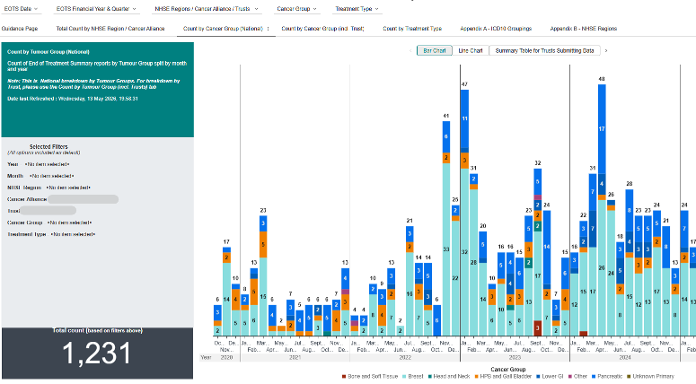
This dashboard is a data quality and completeness tool for End of Treatment Summaries (EOTS) sent to the patient and their GP in the reported month(s) (report covers period from October 2020 to the most recent month of COSD data submission, i.e. both COSD v9 and COSD v10 data). Please read the relevant section of the COSD User Guide for further detail on data collection.
The purpose of the data in this dashboard is mainly ‘ascertainment’, enabling Cancer Alliances / trusts and teams to check for data completeness, accuracy, and timeliness of uploads to COSD, thus allowing them to rectify issues prior to formal extracts being run.
The dashboard can also be particularly useful for making rough comparisons between Cancer Alliances, trusts and teams.
IMPORTANT: The data presented in this dashboard is intended only to support the above stated aims and is not suited for other analysis.
Acknowledgement
This work uses data that has been provided by patients and collected by the NHS as part of their care and support. The data is collated, maintained and quality assured by the National Disease Registration Service, which is part of NHS England (NHSE).
Purpose
This dashboard is a data quality and completeness tool for End of Treatment Summaries (EOTS) sent to the patient and their GP in the reported month(s) (report covers period from October 2020 to the most recent month of COSD data submissions i.e. both COSD v9 and COSD v10 data).
The purpose of the data in this dashboard is mainly ‘ascertainment’, enabling Cancer Alliances / trusts and teams to check for data completeness, accuracy, and timeliness of uploads to COSD, thus allowing them to rectify issues prior to formal extracts being run.
The dashboard can also be particularly useful for making rough comparisons between Cancer Alliances, trusts and teams.
Cancer Outcomes and Services Dataset
The Cancer Outcomes and Services Dataset (COSD) supports national cancer registration and associated analysis (at local, regional, national, and international level) in addition to other national cancer audit programmes. All NHS providers of cancer services in England have been required to provide a monthly return using this data set for all cancer diagnoses since January 2013.
These reports have been designed to support trust data collection teams, facilitate data improvement work and to enable clinicians and management boards to understand their COSD conformance and the quality of their submissions.
Methodology and reporting frequency
These reports share a common methodology and are derived from an aggregated COSD dataset. The dataset includes counts in specific COSD metrics aggregated by month of diagnosis, provider and broad cancer groups based on ICD10. The dataset is refreshed monthly (beginning of third week) to include all submissions made by providers with dates of diagnosis in the current and previous year.
Data use and limitations
This dashboard provides access to operational and clinical data produced by the National Disease Registration Service (NDRS). The data is derived from sensitive patient level information and is shared to support data quality improvement, service planning, and performance monitoring within health and care organisations.
While the data is de-personalised, small numbers or rare conditions may increase the risk of re-identification. Users must therefore take care when interpreting and sharing outputs.
By accessing this dashboard, users are expected to act in accordance with NHS information governance principles, the Caldicott Principles, and applicable data protection legislation, including the Data Protection Act 2018 and UK GDPR.
Users must ensure that:
- data is used only for legitimate health and care purposes
- data is not used to identify individuals, either directly or indirectly
- data is not shared, reproduced, or used outside authorised environments or without a clear business need
- any onward sharing is carefully considered, balancing the risk of disclosure against the intended benefit, and only shared with appropriate organisations or individuals
- outputs are interpreted appropriately, taking account of limitations in completeness, timeliness, and accuracy
- published or shared data relates only to their own organisation or is benchmarked against England-level data
- any published outputs meet anonymisation standards
- advice is sought from local Information Governance teams or a Caldicott Guardian where there is any uncertainty or risk
Permission must be sought in advance of any publication that includes Welsh and/or Scottish data from:
- email Public Health Wales
- email Public Health Scotland
When publishing data please ensure to follow the guidance for staff and stakeholders about how and when to acknowledge the use of NDRS data.
If you have any concerns about data use, interpretation, or disclosure risk, please email the NDRS team at nhsdigital.ndrsdatahub@nhs.net
Feedback and support
We intend this dashboard to be as useful as possible to the community and aim to improve them to meet user needs. Please send any feedback to nhsdigital.ndrsdatahub@nhs.net
Please do not include sensitive or patient identifiable information.
Last edited: 17 July 2026 11:49 am
