Patient information changes
This page outlines two changes to the NHS e-Referral Service (e-RS) that will give patients clearer information and more ways to manage their care. Patients will be able to see service contact email addresses where available, and additional treatment waiting time information will help patients and referrers make more informed choices about where to receive care.
1. Service email addresses available to patients in the NHS e-Referral Service
Patients will be able to see the contact email address in Manage Your Referral (MYR) and relevant patient letters, where an email address is provided by the service.
This change will give patients an additional way to contact their hospital or clinic about their referral. Wherever the patient is provided with the telephone contact details for the service, for example when a referral request has been sent or the patient has been deferred to provider, they will also see the email contact details.
This gives patients an additional way of contacting the service and flexibility in contacting service at a convenient opportunity when they need to follow up their referral.
Why this change is being introduced
The NHS e-Referral Service (e-RS) already allows service providers to add a patient-facing email address to their service information in the Directory of Services (DoS).
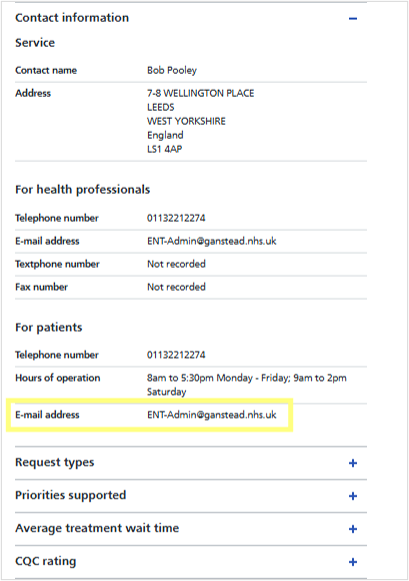
This email address is also displayed to referring users within e-RS.
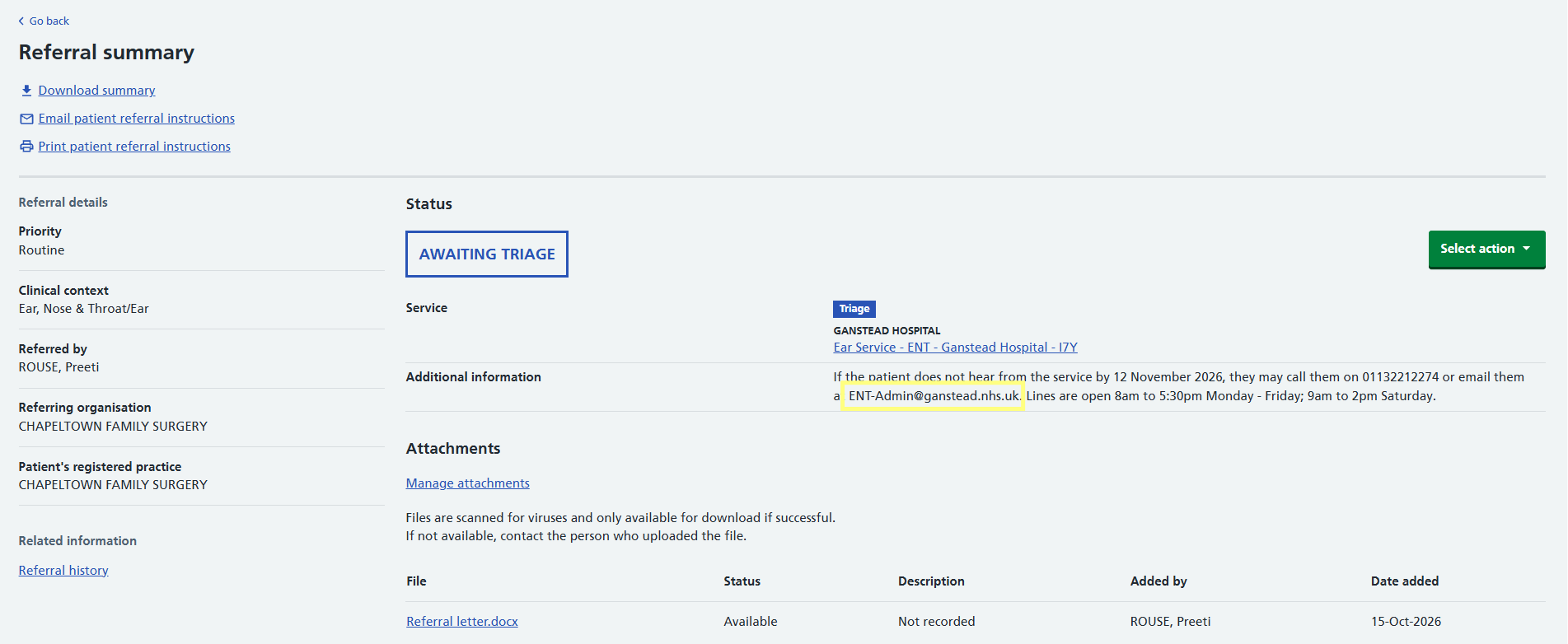
This change extends the use of this information so that, where a service has provided a patient email address, patients can also see it when managing their referral through MYR and in relevant patient letters.
What patients will see in letters
The service email address will also be made available in the:
- patient referral instructions
- patient appointment details
Where a patient email address has been provided for the service, it will be displayed as an alternative contact method alongside the telephone contact details.
The wording within these letters will also be updated to advise patients that they can use the contact details provided if the clinic has not contacted them by the specified date.
What organisations need to know
Service providers can provide a patient-facing email address as part of their service information in the e-RS Directory of Services. Where this information has been provided, it can be presented to patients alongside the service telephone number in MYR and relevant patient letters.
This gives patients an additional way of contacting the service and flexibility in contacting service at a convenient opportunity when they need to follow up their referral.
Where an email address has been added to a service, the provider must ensure it is always monitored and patient enquiries are managed appropriately.
2. Additional treatment waiting time information in the NHS e-Referral Service
Patients and referrers will be able to see additional treatment waiting time information when using the NHS e-Referral Service (e-RS), helping them to better understand potential waits and make more informed choices about where care is provided.
A new '8 in 10 patients get treated within' measure will be displayed alongside the existing average treatment wait time.
Why this change is being introduced
Waiting time information can help patients and referrers understand how long a patient may wait for treatment at a particular provider for a particular specialty.
Displaying the 2 measures together will provide a more realistic understanding of potential treatment waiting times and help patients and referrers make better-informed choices. It will also support greater consistency in the waiting time information presented across NHS services, including My Planned Care, e-RS and the NHS App.
What patients will see
When using Manage Your Referral (MYR) to select a clinic, patients will see:
- first appointment wait time (if the service is an appointment service)
- average treatment wait time
- the new 8 in 10 patients treated within wait time
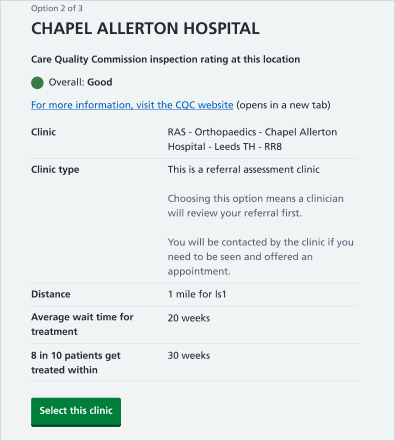
The Average wait time for treatment and new '8 in 10' treatment waiting time will only be displayed where this information is available.
This gives patients additional information to consider when comparing their clinic options and making choices about their care.
What referrers will see
Waiting time information will also be updated in the professional e-RS application.
The new '8 in 10' treatment waiting time will be available when viewing:
- referral service search results
- advice service search results
- service details
- the review service options page
An example of the 'Referral service search results' screen, post release, shows the additional column displaying the new '8 in 10 patients get treated within' measure alongside the existing average treatment wait time.
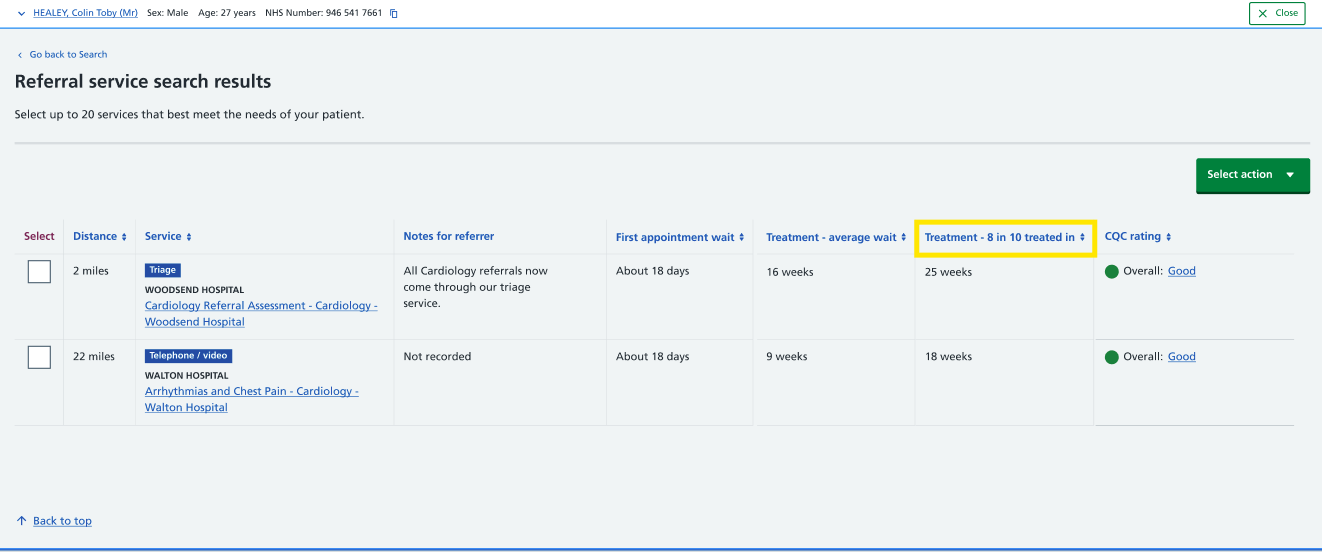
Some existing labels will also be updated to make the different waiting time measures clearer. For example, service search results will distinguish between 'First appointment wait', 'Treatment - average wait' and 'Treatment - 8 in 10 treated in'.
What organisations need to know
The new waiting time measure will be supplied to e-RS through the existing referral-to-treatment (RTT) data feed. The existing average treatment wait and first appointment wait information will continue to operate alongside the new measure.
Last edited: 20 October 2026 5:29 pm