Restricted services supporting alternative care pathways and the NHS e-Referral Service
Guidance for service providers to use e-RS restricted services and alternative care pathways.
Service providers can restrict access to any service within the NHS e-Referral Service (e-RS), for one of a few pre-defined reasons. If a service is ‘restricted’ in e-RS the provider organisation must state the reason and define at least one clear pathway to that service, by specifying which services, organisations and/or individual clinicians are ‘authorised’ to access the service.
An ‘Authorised Referrer’ or an ‘Authorised Organisation’ can initiate a referral directly to a ‘Restricted Service’; whereas an ‘Authorised Service’, is able to Redirect or Onward Refer to that service.
When might a provider wish to restrict a service
Single Point of Access (SPoA)
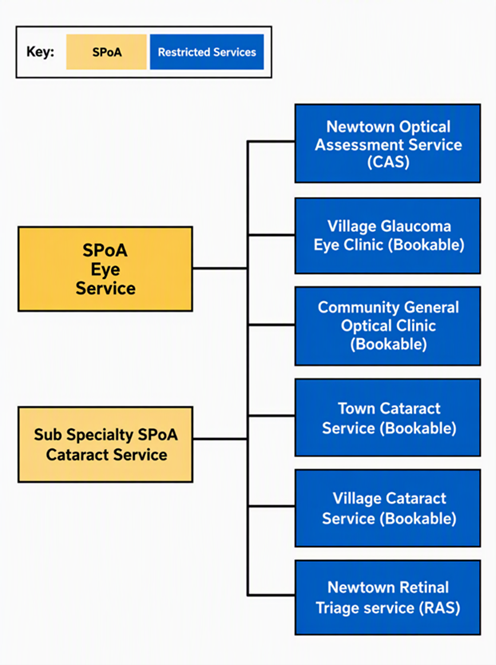
Services designated as a Single Point of Access (SPoA) require all related services to be restricted, so referrals can only be made through the SPoA. Once a specialty or sub-specialty SPoA is implemented, no other service types—including directly bookable, referral assessment and clinical assessment services—can receive direct referrals within that specialty or sub-specialty. Service definers must therefore restrict services that share the same specialty and clinic type, ensuring that initial referrers see only the relevant SPoA when creating a request.
Providers with services which are not designated as a SPoA will need to ensure referrals or advice received can be onward referred or converted from the SPoA into the restricted service. Authorising SPoAs can be performed at either Service level (i.e. individual authorised SPoA) or at Organisation Level (recommended option).
Multiple care pathways
There may be some services where it has been determined that prior clinical assessment is required before gaining access to the service. This might be to ensure that the most appropriate care pathway is selected for the patient. This can be achieved by making such services ‘restricted’ and ensuring that an ‘authorised’ assessment service exists that is able to clinically assess the referral and then re-direct or onward refer to the ‘restricted’ service. This applies to services on both the primary care and secondary care (national) menus. The service should only be restricted if it is in the clinical interest of the patient and must not be used as a means of managing demand.
Locally commissioned services
Where a commissioning organisation has locally commissioned services available to its referrers only, there is no need to use e-RS service restriction functionality. In addition to commissioning services for all referrers within an ICB, there is also the ability to commission services in e-RS at referring practice level which means that only those practices selected will be able to locate the service. This removes the need for restricting services so that only specific referrers or referring practices can locate the service.
Providers need to be aware that, as with any onward/refer-on pathway, once a restricted service has been shortlisted by any form of triage or pathway service, then the patient (via manage your referral or the appointment line) is potentially able to see the details of the shortlisted service(s) and could therefore book an appointment into it. The service restriction relates to which clinical users can select the service for a referral; once selected (shortlisted) it can be booked into, as with any other shortlisted service.
When must a provider NOT restrict a service
Providers must NOT restrict access to services, including SPoAs, in order to artificially manage demand and capacity. Those delivering services under legal right to Choice and the terms of the NHS standard contract must adhere to their contractual obligations. Secondary care services should only be restricted when they are not ordinarily accessible as a direct GP referral. Such restrictions must be agreed and monitored by the lead commissioning organisation.
Where locally commissioned pathways (i.e MSK) are in place, providers will consider restricting their secondary care services so that local referrers can only refer to the locally commissioned service and not direct to the secondary care service. However, providers must ensure that other referrers, who do not have access to the locally commissioned service, can still refer into their service.
Services that are not subject to patient choice e.g. urgent suspected cancer will need to be commissioned locally.
Models
We have provided some diagrams to illustrate models that restricted services functionality can support.
Tertiary or restricted secondary care service model
In this example, the National Eye Hospital offers specialised tertiary services. These services are published in the Directory of Services (DOS) as restricted services. The DOS entry lists all available, authorised services that referrers can initially access.
Clinicians within the authorised services can redirect to or (where they themselves are a clinical assessment service) refer-on to the restricted services, where clinically appropriate.

Clinical assessment model
In this example, the Local Commissioning Organisation has commissioned Newtown Hospital to provide an orthotic service and The Village Hospital to provide a specialised podiatric service, with surgical input. The Local Commissioning Organisation also provides a community physiotherapy service. All of these services are restricted services and do not accept referrals directly from GPs within the Local Commissioning Organisation.
The pathway to all these services is via the Newtown musculoskeletal assessment service. This service is an authorised service for the others. Referrals received into this service are triaged and/or treated. Those referrals that are clinically appropriate can be referred-on to the relevant restricted service.

Referral Assessment Service Model
In this example, the local paediatric referral pathways are complex and referrers often refer into an inappropriate service so the service provider has set up a referral assessment service (RAS).
The RAS takes all paediatric referrals for the hospital, triages the referral and where appropriate, passes the referral on to the appropriate clinic. The specialist paediatric clinics are all restricted and the RAS is the only service that is authorised to refer into them.

Authorised Referrer Model
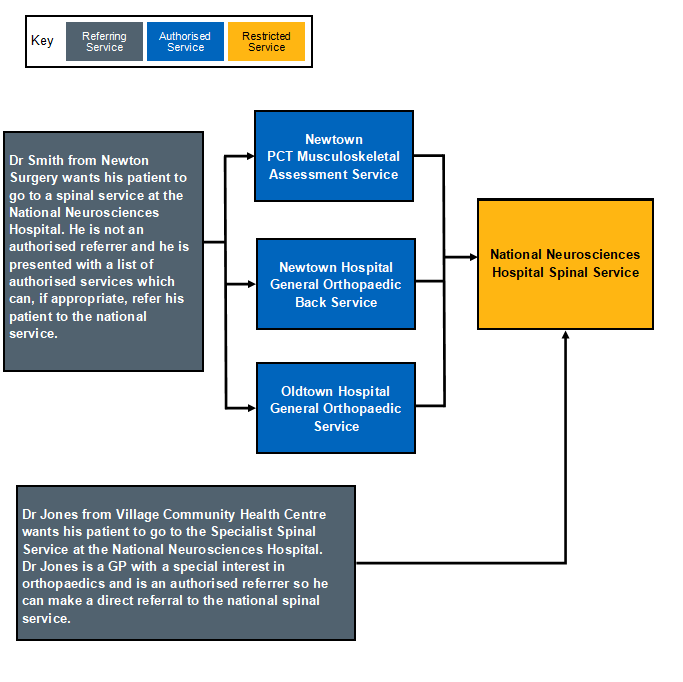
In this example, two GPs at neighbouring practices are looking for an appropriate service for their patient who has a spinal problem. When the service results appear the second GP (Dr Jones) can see that the National Neurosciences Hospital Spinal service might be appropriate (he has been identified by the spinal service as an authorised referrer). As this service is restricted it will not display for the first GP (Dr Smith) as he is not an authorised referrer. This GP sees, within the search results, a list of alternative services which are authorised to refer to the National Neurosciences Hospital Spinal Service, if appropriate.
Authorised Organisation Model
Newtown Commissioning Organisation has commissioned a local vasectomy service for only the practices in a specific location or primary care network. This service is therefore defined as a restricted service. The service is an initial referral service but is restricted to authorised organisations - those individual practices for which the service has been commissioned.
Practices in Oldtown Locality are unable to see, or refer into, the Newtown Locality Non-Scalpel Vasectomy Service.
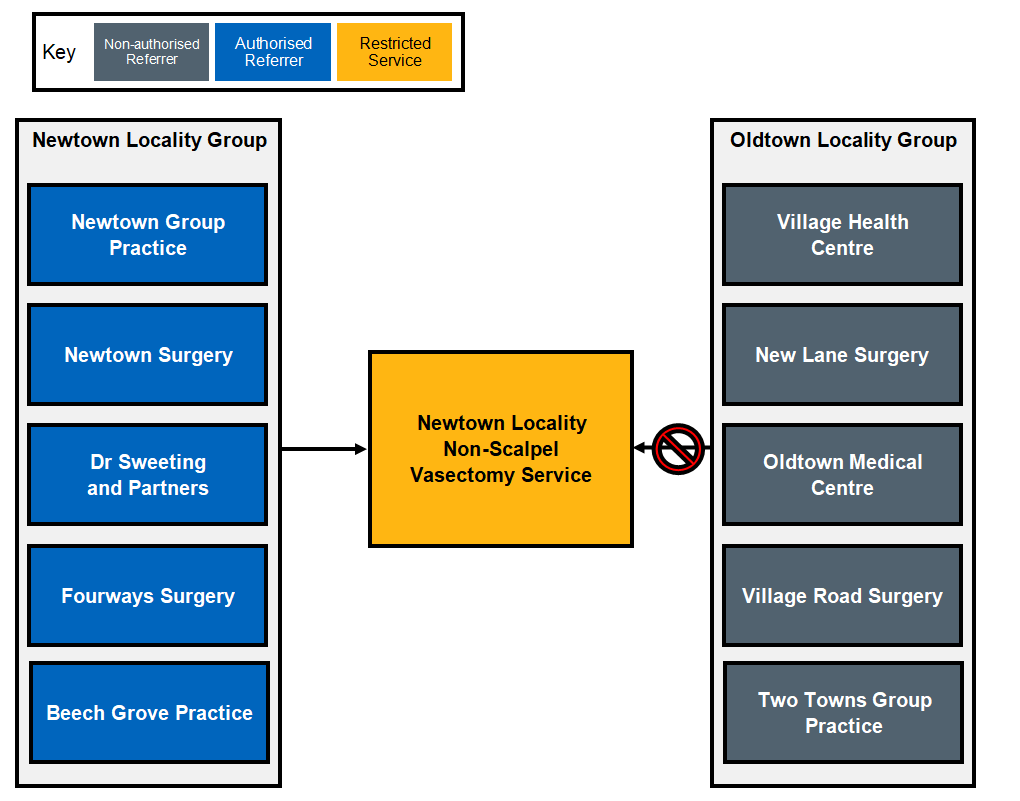
This model uses service restriction to support this process, but the ability to commission services in e-RS at referring practice level means that only those practices which have commissioned a service will be able to see and refer into it. This removes the need for such services to be restricted and may be a more effective model for primary care menu services.
Service restrictions and wait times
Please visit the e-RS pathway start date page for further information on when the pathway start date is recorded for e-RS referrals and Advice and Guidance (A&G) requests. This page was updated in October 2026 to reflect a change to the pathway start date calculation for A&G requests which are converted to a referral.
Service restrictions and patient choice
Under the NHS Constitution, a patient has the right to choose any clinically appropriate provider for their elective care and, under the terms of the current Standard NHS acute contract, providers MUST make all their consultant-led elective outpatient services available on e-RS.
If providers are going to make any of their services restricted, they must ensure that at the point at which a patient moves from primary care to secondary care, they have the opportunity to discuss and exercise their choice options.
The role of the commissioner
Commissioning a service within e-RS means that a referrer belonging to that commissioning organisation (currently, the Local Commissioning Organisation to which their practice belongs) is able to refer to that service. The service will be displayed when the referrer selects 'Search' button on the 'Search for a service' screen within the application.
All services subject to Patient Choice are available in e-RS for all referrers in England and there is no requirement or option to commission a service.
Where a local commissioning arrangement is in place between a healthcare provider and ICB, services published on e-RS still need to be commissioned to allow a referring practice to locate the service. If, however, a service has been ‘restricted’, then it will only be visible to the referrers who are authorised users or members of authorised organisations (for example GP practices) will be able to refer to it.
The ability to commission services in e-RS at referring practice level means that only those practices which have commissioned a service will be able to see and refer into it. This removes the need for such services to be restricted. If commissioning at practice level is used, then there would not be a need for the provider to restrict the service.
The role of the service definer
Within a provider organisation, there will be at least one member of staff (ideally more than one) who ‘defines’ and updates services for that organisation within e-RS. This is undertaken by a user with the e-RS Service Definer role.
To enable the restricted service to be published, the service definer must first add one or more of the following to the service:
- authorised service
- authorised organisation
- authorised referrer
Choosing to apply restrictions will prompt the service definer to select one of the following reasons:
- practice based commissioning
- prior approval service
- prior assessment required
- specific pathway required
- tertiary service
- other (comments are then required as a mandatory field)
Identified pathways for referrers
When a referrer has entered specific search criteria and services are returned they will be able to see, and refer directly into, services that they are authorised to access.
Where a referrer is unauthorised, services that are ‘restricted’ will not be displayed in the referral service search results screen.
Auditing
There is a restricted services enquiry for providers and service quick search for service definers and referrers within e-RS. This enables commissioners, referrers and provider organisations to see any restricted services. This is not limited to their organisation but includes any organisation in the directory of services. The enquiry or quick search will return the service name. Click on the service name to reveal further details, such as,
- service details - location, type of service
- contact information
- referral criteria, such as, conditions treated, procedures performed, exclusions
Last edited: 6 October 2026 12:48 pm