Introduction
For many years, the eight Regional Cancer Registries in England provided a vital service to NHS Clinical Genetics Teams, enabling them to check cancer diagnoses to facilitate accurate genetic counselling. In 2013, all eight registries came together to form a single national service, which is now part of the National Disease Registration Service (NDRS). On 1st January 2019, NDRS launched the Genetic Information Request Portal (please note this opens in a new window), enabling all Genetics Services on the Health & Social Care Network (nhs.net) to request and receive cancer diagnosis information for English patients via a modern and secure interface.
The information on this page provides guidance to NHS Clinical Genetics Services using the Genetic Information Request Portal to request information on a person who is believed to have been diagnosed with or treated for cancer in England.
If you work for a genetics service outside of the NHS, e.g. overseas, you can request information by emailing us at [email protected].
If you require cancer diagnostic information on a non-English patient residing in Northern Ireland, Scotland, or Wales, please contact the appropriate national registry – contact details and submission processes are provided in the Appendix.
In order to log into the portal, each Genetics Service or Cancer Family History Clinic will need its own service-wide nhs.net email account. For information governance reasons, we do not allow individual named nhs.net accounts to have access to the portal. Shared service-wide nhs.net email addresses are added to and maintained on a whitelist of authorised users. The whitelist ensures that only authorised personnel have access to the portal, and it is reviewed annually to ensure appropriate continued access.
For GDPR and audit purposes, a named Requesting Consultant must be provided for each genetic request.
Responsibility for appropriate use of access rests with the requesting genetics service, and genetics services take on sole data controller responsibility for any confidential patient information received from NDRS.
Dedicated national Genetic Processing Officers will process and return genetic requests for cancer diagnosis information by automation to the requesting nhs.net email account within ten working days from date of submission. Patient demographics provided on the genetic request will be used to locate a match to patient data stored on Encore, the database used by the National Cancer Registration and Analysis Service (NCRAS), as well as regional legacy systems where these exist.
From April 2026, we are now including information from the National Inherited Cancer Predisposition Register (NICPR) in our genetic request responses. The NICPR data details (likely) pathogenic variants in genes associated with all inherited cancer predisposition syndromes (with the current exception of Lynch syndrome, as this data is currently in a separate system). Pending technological development, we plan to include the Lynch syndrome-associated variants, as well as laboratory data indicating whether a patient has been tested for (a) variant(s) in any cancer susceptibility gene(s).
Logging into the portal
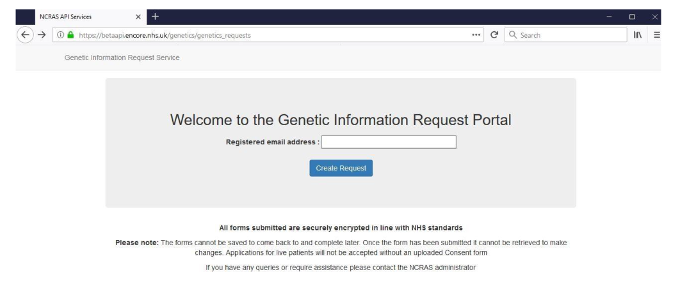
A registered nhs.net email address is required to log in to the Genetic Information Request Portal (please note this opens in a new window). Once logged in, simply click on 'Create Request'.
The email addresses must be generic rather than belong to a named individual within a genetics service and will be maintained on a whitelist to ensure only appropriate staff are allowed access to the portal. Any email address amendments or additions should be sent to [email protected] to ensure access is provided to and maintained for valid services.
Image of the genetic information request portal welcome page:
Genetic information request form
After logging in, you will be taken to the Genetic Information Request Form. The top of the page includes the email address and service name of the requester, and the Genetic Service Information held. If any of this information appears incorrect and needs updating, please contact us at [email protected] Family (Proband) number/reference should be input and a Requesting Consultant must be chosen from the dropdown list. Both are mandatory fields, as indicated throughout the form by an asterisk.
Making a request
If the requesting consultant’s name does not appear in the dropdown list, use the ‘Other’ option and type the consultant’s name into the free text box, which will appear below the Requesting Consultant field. If a consultant is not chosen from the dropdown list, or if ‘Other’ is selected and no name is entered into the text box, the request will not be submitted and an error will appear stating ‘Please choose or provide a consultant’. If ‘Other’ is selected and text is entered into the text box which appears, but then a consultant name is chosen from the dropdown to replace the ‘Other’ choice without removing the text, the same error will appear.
If a consultant needs to be added to or removed from the dropdown list for your service, please contact [email protected] with the consultant's name and GMC code to be added or removed.
The image below shows the top of the genetic information request form with requested by and genetic service information, including mandatory field 'Family (Proband) number/reference' and 'Requesting Consultant'. The error alert is shown when ‘Other’ Requesting Consultant is chosen without entering a name into the text box:

The remainder of the request form is where patient demographics and any known cancer details can be populated.
The mandatory fields which must be populated are:
- surname
- forename
- sex
- date of birth
- vital status
- address
Dates
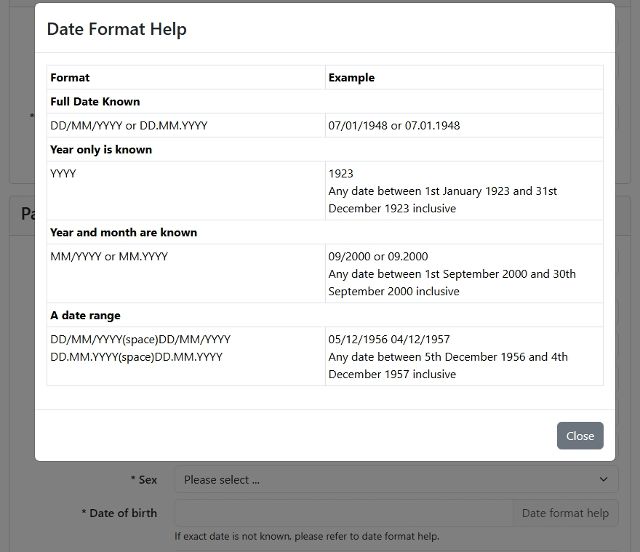
Date of birth, date of death, and date of diagnosis fields can be recorded as a full date, a month range within a specified year, a year range, or a range between two specific dates. Date ranges for all date fields can be given by including a space between two dates.
Date format help is available beside all date fields; the more precise and accurate the provided dates, the greater the likelihood that a match will be found.
The cancer registration database cannot search for dates of birth prior to 1880. Matches for old records tend to be less common and, if found, may be less detailed.
The image below shows the date format help screen - more specific accurate dates increase the likelihood of a patient match.
Mandatory fields
If you attempt to submit a genetic request which does not include a mandatory field, or for a living patient without uploading a consent form, the request will not be submitted: any missing fields will be highlighted in red with a note that they can’t be blank or that a consent form must be uploaded.
The image below shows an example of mandatory fields such as sex and vital status. Requests with missing mandatory fields will not be submitted and missing fields will be highlighted in red text with a comment beneath:

Vital status and Consent
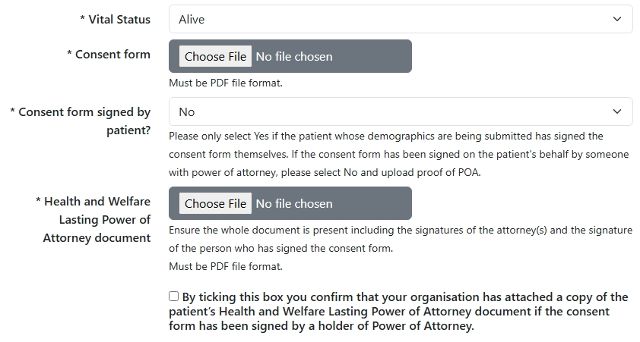
For patients with Vital Status Alive, a consent form signed by the patient or a relative with legal Power of Attorney must be uploaded by clicking Choose File and selecting the appropriate PDF. Consent forms must be in PDF format and the check box must be ticked to indicate a signed consent form has been provided.
Services uploading consent forms signed by a person holding Power of Attorney (POA) must also upload proof of POA in order for the consent form to be valid. In the dropdown field ‘Consent form signed by patient?’, select the option ‘No’ and then upload proof of POA in the box below and tick the POA check box to confirm. The full POA document should be uploaded to ensure that the patient information and the POA’s signature is shown.
When requesting diagnosis data relating to a child or young person under the age of 16, we will accept a consent form signed either by a person with parental responsibility or by the child themselves if they have been assessed by the genetics service as Gillick competent. It is the responsibility of the referring genetics service to determine the most appropriate signatory and to ensure that any assessment of competence has been undertaken where appropriate. In this situation, when completing the dropdown field ‘Consent form signed by patient?’, select ‘Yes’ and ensure that the consent form clearly identifies the signatory and their relationship to the child or young person.
The expectation is that young people aged 16 and over will provide their own consent and sign the consent form. However, we may accept a signature from a person with parental responsibility where the genetics service has determined that the young person lacks capacity to provide informed consent, or where there are other exceptional circumstances documented by the referring service.
Consent and power of attorney forms will be stored and regular audits will be carried out to ensure organisations comply with data regulations.
Submitting genetics services have legal responsibility for ensuring data compliance by providing appropriately signed consent and power of attorney forms. Any genetics service which fails to supply signed consent and power of attorney forms may be liable to have their access to the portal revoked.
The image below shows the 'Patient Information' fields for living patients and the consent form upload and check box.

When Vital Status Deceased is chosen from the dropdown menu, a Date of death field will appear instead of the consent form field. Deceased patients on requests who appear alive on NHS Summary Care Record tracing will be returned unactioned with a response comment that the patient is alive on tracing. A new request will need to be submitted with either a signed consent form if the patient is living or with proof of death emailed securely to [email protected] beforehand. A note in the comment box that proof of death has been emailed should be included to ensure appropriate return.
The image below shows the 'Patient Information' fields for deceased patients which includes the 'Date of death' field. Whilst the 'Date of death' is not mandatory, it will help with a positive result if completed.

Repeat Requests
If submitting a repeat request due to receiving further demographic information from the family or an error with the initial request, please tick the box at the bottom of the page to indicate it is a repeat request and complete the field ‘Repeat request ID’ with the API reference of the initial request.

Traceable strength
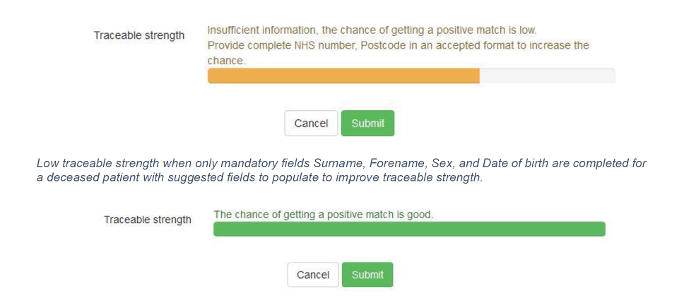
A traceable strength bar at the bottom of the page updates as fields are populated to indicate the likelihood – low or good – that a patient can be traced or a match identified on Encore. A valid NHS number greatly increases the chance of a positive match: including an NHS number is the gold standard to identify the correct patient.
A low traceable strength is when only mandatory fields Surname, Forename, Sex, and Date of birth are completed for a deceased patient with suggested fields to populate to improve traceable strength.
A good traceable strength is when NHS number is populated in addition to Surname, Forename, Sex, and Date of birth for a living patient. A consent form would need to be provided before submitting.
If submitting requests for multiple family members, it can be helpful to include in the comments box the family/proband or genetic request reference number (provided on the submission confirmation page pictured below) for requests for other family members.
Submitting a request
Review all fields carefully, because requests cannot be amended once submitted. After clicking submit, the following page will confirm the request has been submitted and will be completed within ten working days.
The below image shows the genetic information request submitted confirmation screen and example reference ID:

Urgent Requests
We will endeavour to accommodate urgent requests in exceptional and occasional circumstances, such as an imminent genetic counselling appointment. If you require a request to be looked at urgently, please do not state this on the request itself, because each request passes through several automated stages before being reviewed by a person, by which point it may be too late for us to respond to you in time. Instead, after submitting the request(s) that need to be completed urgently, please email [email protected] and give as much information about the request(s) as possible, including the individual API reference number(s), the family/proband reference number, the date and approximate time of submission, and when you need it returned by. This will enable us to locate the request(s) and respond to them as quickly as possible.
Important patient search notes
How to Improve Rate of Patient Match Return
To identify the correct patient match from hundreds of thousands of patients on the cancer registry system, genetic processing staff manually check additional patient information provided at the time of the patient’s cancer diagnosis.
To increase the chances of a patient match being found, genetics services should provide as much information as possible. This can be done by:
- populating more fields
- ensuring all patient names are spelled correctly and are in the correct fields
- adding extra information in the comment box, including whether additional requests were sent for the same proband number to correlate family location and historic names
While an NHS number is the gold standard for finding a patient match from specific information, any information a genetics service knows and provides can be used to narrow down a patient match – the more specific this is, the better.
Please also remember that patient demographic information (e.g. address, surname) is captured within the cancer registry system at or around the time of cancer diagnosis. The cancer registry might not receive up to date patient details if, for example, there is no ongoing cancer treatment or recurrence. For this reason, please endeavour to provide us with patient demographic information for the time of diagnosis. If the date of diagnosis is not known, please specify in the comment box that demographic information provided on the genetic request form might differ from demographics at date of diagnosis.
Please note that consent forms will not be checked for supplementary demographic information. Genetics services must provide all known information on the Genetic Information Request Portal form.
The cancer registry system holds millions of patient records to search, with new data received by NCRAS every day. The more patient demographic information genetics services provide, the better the chances that the correct match can be found.
To help our genetic processing officers to provide the best service for your clinic, patients and families, please try to ensure information from patients and their relatives is present and as specific and detailed as possible on the Genetic Information Request Portal form.
Genetic email responses
Genetic request responses will be generated by Genetic Processing Officers (GPO) on the cancer registration system and emailed by automation from [email protected] to the account used to submit them.
All available data from the cancer registry and local legacy systems will be checked to ensure a match is identified where possible, however if we cannot find a match and the information on your original request was sparse, it may be worth seeing if you can obtain any further information from the family and resubmitting.
Genetics services take on sole data controller responsibility for confidential and sensitive patient identifiable data received by NDRS. Genetics services should ensure the appropriate handling, storage, and sharing of any data. Genetics services are responsible for ensuring that data provided by NDRS is stored in the relevant family file, including printed out genetic response emails.
Below is the format the automated email response will take and the fields which will be included where provided.

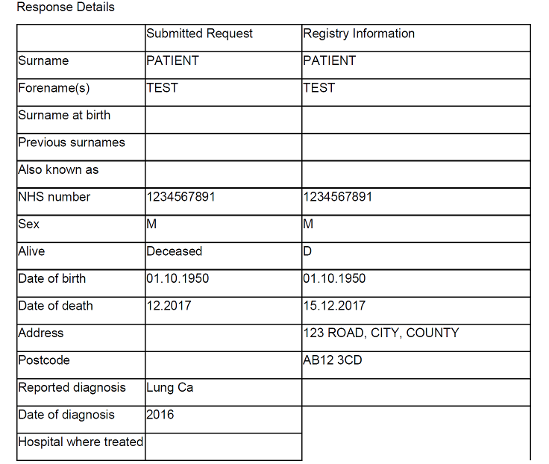


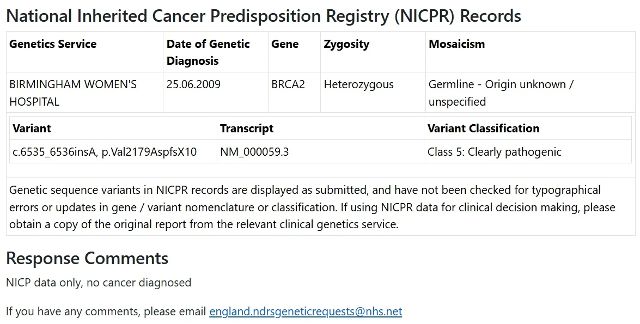
Response Comments will confirm if no patient has been found, and there will be no patient demographics or tumour details from NCRAS. Patient demographics sent by genetics services will still appear for patients with no trace, and this should not be confused for a cancer confirmation.
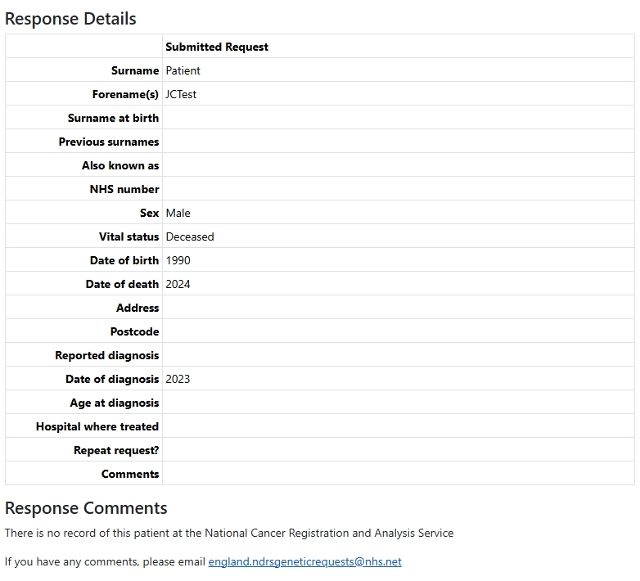
Response Comments is also where a request for a deceased patient on the submitted request with a living patient on NHS Summary Care Record tracing will explain why the request has not been actioned and explain that a new request should be submitted with either a signed consent form uploaded on the portal or a death certificate emailed to [email protected] as proof of death.
The new request will be returned within a new ten working day timeframe. The response time for a repeat request due to a vital status mismatch or insufficient or incorrect information is not included in the ten working days of the initial request.
Tumour Details
Tumour registrations held by NCRAS may be recorded as the following statuses:
- final - A complete registration for a confirmed cancer diagnosis. As data continues to be provided from various sources, these registrations may accumulate further details of molecular testing, treatment, recurrence, or nodal or metastatic spread
- provisional - An open registration undergoing current investigation
- treatment-only - Used in rare instances of an extra-regional diagnosis with local treatment given. Little or no diagnostic information may be available
Genetic responses will include all final, provisional, and treatment-only tumour registrations held for a patient. Molecular data received for genetic tests carried out by participating laboratories since 2016 will be included if present. Pathology data on mismatch repair (MMR) gene expression has been recorded since 2019. Molecular diagnostic information will include:
- the laboratory name
- the date the test was performed, reported, or authorised
- test status
- gene
- whether the sample was somatic (tumour specific) or germline (inherited, familial)
Genetic request cancer information sent to genetics services by NCRAS relate to cancer diagnosis data extracted from various data sources. Genetic request responses will supply:
- tumour site
- histology/morphology
- laterality
- all diagnosis and treating hospitals
- molecular/genetic status if known
- NICPR data if received
The most current, specific confirmed information available is provided, though it may be a non-specific tumour site or histology/morphology if a more precise diagnosis could not be confirmed e.g. carcinoma NOS.
Example of data fields
Examples of varying levels of information specificity to include on the Genetic Information Request Portal to help identify a patient match include:
|
Field |
Bad |
Better |
Best |
Ideal |
|---|---|---|---|---|
|
Forename(s) |
Meg |
Meg Juliet |
Margaret Juliet |
Margaret Juliet with ‘Meg’ in Also known as field |
|
Date of birth |
1950 1959 |
1950 |
01.09.1950 30.11.1950 |
13.11.1950 |
|
Date of death |
None supplied |
None supplied, but comment box populated with ‘Died in their 80s’ |
1995 2000 |
25.08.1999 |
|
Address at diagnosis |
Unknown |
London |
Westminster, London |
Buckingham Palace, London with ‘SW1A 1AA’ in Postcode at diagnosis |
|
Hospital treated |
None supplied |
North of England |
Yorkshire |
Hull Hospital |
|
Reported diagnosis |
None supplied |
Pelvic cancer |
Gynaecological |
Right ovary |
|
Date of diagnosis |
None supplied |
None supplied, but Age at diagnosis field populated |
2010 |
08.04.2010 |
Glossary
|
Acronym |
Description |
|---|---|
|
DOB |
Date of birth |
|
DOD |
Date of death |
|
Encore |
The database used by NCRAS |
|
GPO |
Genetic processing officer |
|
NCRAS |
National Cancer Registration and Analysis Service |
|
NDRS |
National Disease Registration Service |
Contact list
Dr Steven Hardy - Head of Genomics & Rare Disease
Tel: 07970 225 954
Dr Fiona McRonald - Genomics Programme Manager & Scientific Lead
Tel: 07920 244 581
Genetic Requests team inbox
Contact details for other UK cancer registries
Northern Ireland
N. Ireland Cancer Registry
Centre for Public Health
School of Medicine, Dentistry & Biomedical Sciences
Queen's University Belfast
Mulhouse Building
Grosvenor Road
Belfast
BT12 6DP
Tel: +44 (0)28 9097 6028
General and Genetic Requests | N. Ireland Cancer Registry
Scotland
Public Health Scotland
NHS National Services Scotland
Area 151A, First Floor
Gyle Square, 1 South Gyle Crescent
Edinburgh
EH12 9EB
Email: [email protected]
Scotland genetic requests website
Wales
Public Health Wales
Knowledge Directorate
Welsh Cancer Intelligence & Surveillance Unit
Floor 5, Capital Quarter 2
Tyndall Street
Cardiff
CF10 4BZ
Tel: +44 (0)2920373500
Last edited: 31 July 2026 5:43 pm
